
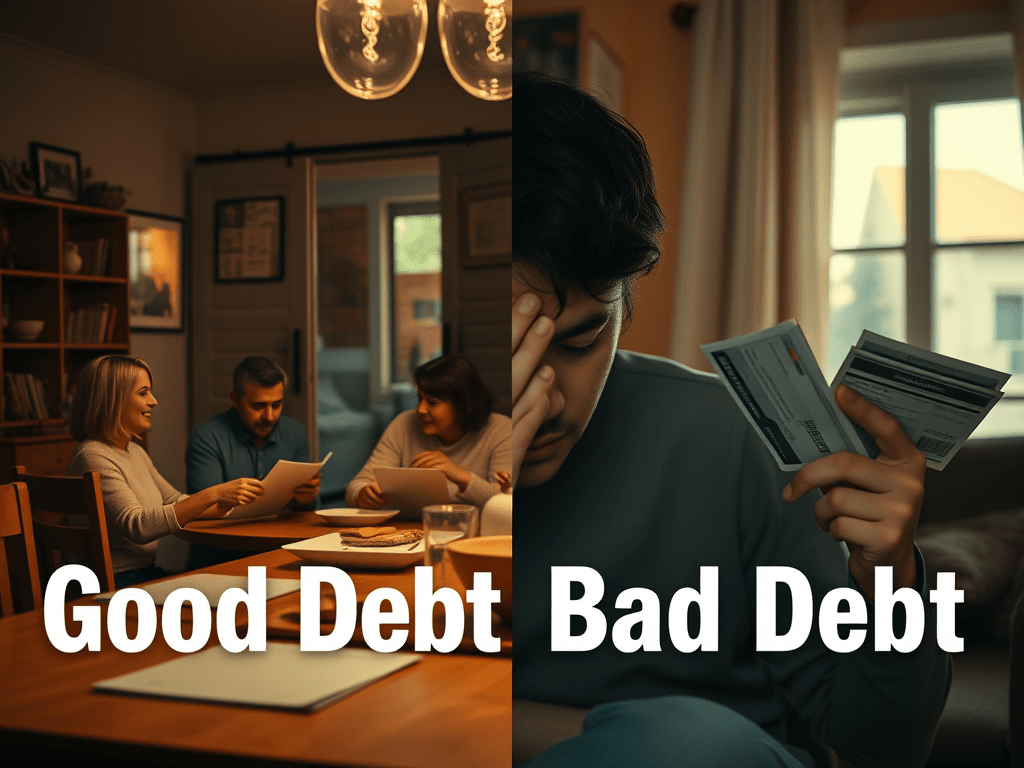
We have a love-hate relationship with debt, and assume most people do as well. Sometimes, we justify debt as good, especially when it serves the purpose long-term. And other times, we run like hell away from it. Here is how we break it down for ourselves.
Good Debt is purposeful borrowing, like that responsible friend who lends you their umbrella when it’s pouring outside. It serves a purpose. Examples include:
- Mortgages: Taking out a mortgage to buy a home. After all, having a roof over your head is generally a good life goal (unless you’re secretly a hermit crab). If the math works out for buying, instead of renting then great. If not, its a sentimental reason, which can help with mental wellbeing, and this will help financially in other ways.
- Student Loans: Investing in education. These loans often have lower interest rates, especially if they’re federal loans. So, pursuing that degree? Good move! Again, type of education, institution, type of degree, field of study and longevity of careers after the education proves critical in this step.
- Business Loans: If you’re starting a business, borrowing to fund it can be considered good debt. It’s like planting seeds for future financial growth.
- Net Worth Boost: Good debt tends to increase your net worth or have future value. It’s like planting a money tree (okay, not literally, but you get the idea).
Now let’s talk about the worse half of this story. Bad Debt is the Sneaky Saboteur, like that impulsive purchase you regret the moment you swipe your credit card. Examples include:
- High-Interest Credit Card Debt: When you carry a balance on your credit card and the interest starts doing the cha-cha with your wallet. Not fun. In 2011 when S was transitioning between her degree and first full time paid job, she carried credit card debt for 3 months. First, second and third month paycheck went into paying it off. Imagine getting your first paycheck and not blowing it on something fun. S thinks paying off the card was fun.
- Payday Loans: These are like financial quicksand. They’ll suck you in, and suddenly you’re paying sky-high interest rates. Nothing else needs to be said. If this can be avoided, please do so.
- Impulse Buys: That designer handbag you didn’t need? Yep, bad debt. S hates shopping and especially window shopping. She would rather be taking a walk outside in cold freezing rain than in a crowded mall.
- Hurts Your Finances: Bad debt can mess with your financial well-being, credit score and hurt your long term objectives. Like a mischievous squirrel raiding your savings stash.
So, What’s the Verdict?
Balance: Debt isn’t inherently good or bad; it’s how you wield it. Like Thor’s hammer, it can be a powerful tool or a heavy burden.
Responsibility Matters: If you manage debt wisely—paying attention to interest rates, repayment terms, and your overall financial health—it can be a force for good.
Credit Cards: Ah, the double-edged sword. Credit cards can be good (hello, reward points!) if you use them responsibly. But if you’re maxing them out on impulse buys, they turn into bad debt faster than you can say “annual fee.” We can guarantee you that good smart use of credit cards is the way to go. A few years ago, between the both of us, we had 8 credit cards and used each one for a very specific purpose. For each category, we got atleast 5% – petrol, groceries, hotels, flights, and another card each with 0% foreign transaction fee.
Bank accounts: We got very good at making the best of what our local Credit Union offered – with 1 monthly direct deposit, spend minimum of $25 on the credit card, and have 1 monthly direct credit (hello utilities!) and they gave us a 3-%-5% APR rate on the first $10,000 in the savings account, after which it dropped to the standard 0.5%. Post taxes on the interest earnings, this gave us a free cash flow of $350-$400 each month. Each. We set-up individual accounts to maximize this option, and happily split our paychecks from our normal bank joint bank account to allow for this earning. Yes, free cash made the additional paperwork worthwhile.
Remember, my dear friend, it’s all about balance. Debt isn’t inherently evil; it’s just a financial tool. Use it wisely, and you’ll be the Gandalf of your own financial journey!
Now, tell me: Have you ever had a debt-related adventure? Or perhaps you’re debt-free and living that minimalist life? 🌿

 Retire from 8 to 5
Leave a comment